On Communication

Toni Cade Bambara said: “Words set things in motion. I’ve seen them doing it. Words set up atmospheres, electrical fields, charges. I’ve felt them doing it. Words conjure.” Certainly this is true, and yet — What of the “atmospheres, electrical fields, [and] charges” that words alone cannot ignite? What of the modes of relation that grow roots in the water without an alphabet? What can we say about the depth of care and connection that can be “conjur[ed]” in excess of conversation?
(The following thought experiment is best conducted in tandem with a loved one so you can discuss after dreaming up your respective environments.)
Imagine your needs reside in a physical space. The only condition is that the space be capacious enough to accommodate all your needs and desires: Physical, material, emotional, sexual, spiritual, etc., including those that have yet to be named, those that are but a mere quiver under your skin, those that are a wave gathering momentum in the dark, those that are couched in the shadows and waiting patiently to collide with language.
I imagine my needs reside in a cavernous grotto: Dense, latent, and enchanting.
An entire eco-system folded into the face of a cliff, a wide mouth creaking open to meet the world’s immensity with its own shrouded enormity. Here, shadows resemble something closer to echoes of light. Thick swaths of moss line the path that visitors traverse upon their arrival. Hollows of wet rock arc to form multiple entrances. Tendrils of ancient vine suspend from the tree line above and act as a defense against shame; When shame approaches the cave, the vines embrace it with so much force that its life supply short circuits, leaving a smoking pile of possibility in its wake. In the grotto, my needs and desires, regardless of how perverse or taboo they may be, are welcome. The atmosphere encourages equal parts voracity and tenderness.
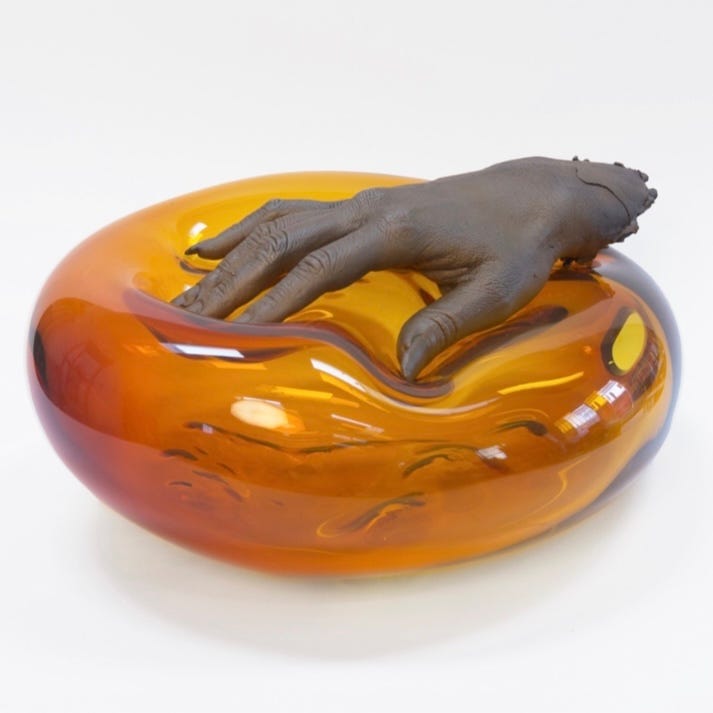
Within the grotto, I can see myself bringing my hands to its damp, cool walls. I linger for a moment, slide my fingers in every direction, step away from the edges, and gaze at my palms, both of which are now saturated in the material of every single thing I have, do and will ever need or desire. The substance is undeniable in its color, texture, and smell; I want to soak my entire body with it, and yet I can’t seem to carry my newly anointed hands back down to my flesh because of one fear and two truths:
Fear — The density of the cave, i.e. the plentitude of the material on the walls, i.e. the magnitude of what I need and desire absolutely terrifies me, partially because I know I cannot satiate it all myself. Ultimately, the depth of my wanting beckons me into a state of dependence on other people. It’s a complicated task, this work of breathing one’s self into a form large enough to love every single need and desire that arises, to trust in all of it, especially those that can only be fulfilled in collectivity.
Truth — I have a habitual impulse to minimize my needs and desires. That tendency is informed by my aversion to depending on other people and years of being socialized to believe the demands of my being are “excessive,” “dramatic,” “too much,” “too big,” “too loud.” (Sound familiar?) I have been falsely led to believe that all I needed to do was want less, all I needed to do was reign myself in, all I needed to do was acquiesce to the notion that I, as a young, queer, Black woman, am not allowed to be as ravenously hungry for a sense of fulfillment as I am.
Truth — While there is a potential cost to expressing a need or desire (the cost being that the person on the receiving end may eschew what is shared), there is also a cost to collapsing the magnitude of what I need and desire, regardless of the context in which this collapsing occurs. The habit of accepting crumbs, whether consciously or subconsciously, operates at my own detriment, always.
As Audre Lorde wrote, “nothing I accept about myself can be used against me to diminish me.” Likewise then, no need or desire I accept (read: release all shame around) can be used against me to diminish me either, which clarifies the task at hand. This means that earnestly affirming the magnitude of what my being craves and the inter-relation that necessitates also means that no one can “[use my needs] against me to diminish me,” nor can they stop me from standing tall behind them, which turns the responsibility back inward.
All of this brings to the fore a searing frustration I’ve been unable to name until now: Our colloquial discussions about the importance of “communication” as it relates to getting our needs met and our desires actualized are incomplete in that I find people are usually referencing verbal communication exclusively, at the expense of what can happen when we abandon our dependence on readily legible language.
But, as Robert Hass reminds us: “A word is an elegy to what it signifies,” which is to say verbal language reduces the signified thing into a ghost of the gravity it holds. Ultimately, the reduction that “a word” demands (i.e. the translation and therefore also the flattening of what “waits inside us like an ache” as Lucille Clifton writes) denotes an inevitable failure to communicate the expanse of our needs and desires through verbal language alone.
What then can we make of the profound but seldom acknowledged value of intuitive, instinctual, haptic, and gestural forms of communication? What of the transmission of information about our needs and desires that happens in complete silence, the sort that’s indeterminate perhaps but potent and nonetheless?
I know there are more plentiful and pleasurable pathways towards satiation out there for us. What I’m proposing is an expanded approach to how we understand, talk about, think about and feel through our needs and desires. Yes, what I am proposing is a growing reliance on forms of communication that deepen the pools of intimacy we wade in with others. And if we understand intimacy on every scale as a primary tool in crafting the worlds we wish to inhabit, this is quite an urgent provocation.
And then, there is the fact that verbalizing my needs and desires sometimes siphons the pleasure out of having them met or received, especially in sexual and emotional dimensions of my life, which brings further significance to the unspoken. To this end, Frida Kahlo told her husband:
“I’m not asking you to kiss me, nor apologize to me when I think you’re wrong. I won’t even ask you to hug me when I need it most. I don’t ask you to tell me how beautiful I am, even if it’s a lie, nor write me anything beautiful. I won’t even ask you to call me to tell me how your day went, nor tell me you miss me. I won’t ask you to thank me for everything I do for you, nor to care about me when my soul is down, and of course, I won’t ask you to support me in my decisions. I won’t even ask you to listen to me when I have a thousand stories to tell you. I won’t ask you to do anything, not even be by my side forever. Because if I have to ask you, I don’t want it anymore.” - Frida Kahlo
Though I certainly understand the function of verbally asking for what I want and the importance of learning to advocate for one’s self, I also echo Kahlo’s sentiments in that there are certain things I do not want to have to ask for. For example, active investment in and attention to my pleasure and spiritual growth are two things I generally refuse to advocate for myself around. This may sound counter-intuitive, but every single person in my core support system shows up for me in both ways consistently without me having to ask — And that’s a special kind of safety because it requires deep relational study and foresight on the part of my loved ones, by those who choose to be in relation with me, which makes me feel special, secure, held, and regarded.
I’m speaking here of the investment it takes to reach a level at which your love’s needs and desires are an instinct, a rhythm nearly as familiar as your own inner workings, something you can anticipate. I want my loves to share in this becoming with me, and I want to share in it with them too. So then, the need is not so much to be cared for, or touched, or considered, or spoken to, or thought of in a particular way. What allows satiation to feel good is perhaps not actually the voicing of need itself, but for the need to be noticed before its verbalized. As Kahlo notes, “if you have to ask you, I don’t want it anymore.”
Consider:
(To find yourself under the weight of an elongated gaze, one you can decipher without the reductive force of phrases — “I need tea,” or “turn down the TV,” or “touch me like this,” or “I don’t want to talk right now, can we just sit together.”)
(Through the way in which your loved one places a hand firmly on your back, which without exchanging words, you understand means — “You seem tense right now, remember I’ve got you.“)
(A slight variation to their regular rhythm of breath and body signals — “I am overstimulated, can we take a beat?”)
The triumphant reverberation of this information lies in the fact that I know what I’m speaking of is possible because I’ve experienced this depth of knowing with my closest friends. There is something enchanting about moments when my consciousness overlaps with a loved ones and they reveal their capacity for keen observation, care, and awareness (which is the cornerstone of love), and moreover, their willingness to dedicate some of their capacity towards turning the volume up on what will bring me fulfillment.
This model also creates space to reckon with the fact that my loved ones sometimes know what I need before I do and, as unsettling as it can feel, I welcome that degree of connection. Even further, I am coming to demand that my loved ones be attuned to my inner world to the extent that they can predict even the things I have not yet told them because they haven’t shown up as sentences in my own head yet. So part of this, too, is dissolving my learned fidelity to seeing myself as an individual body and ushering in forms of intimacy that challenge me to surrender to the fact that, in sum, my loved ones likely know more about me than I know about myself. But that’s the glory of relation, isn’t it? Being witnessed in our totality by people who are also vast enough to shepherd the continuous re-discovery of ourselves.
And then, there’s also the ongoing work of healing our collective orientation towards separation. So what of the perceived split between the knowledge about ourselves, about our needs, we derive from our minds and translate through spoken language and then the knowledge we derive from our hearts, those inarticulable things that cannot be translated, and so instead call silently out for a soft palm on the forehead, a loving glance, an unsolicited but deeply needed pep-talk, a precisely placed kiss, a hot cup of tea appearing at our bedside without asking, and so on and so forth… What of the intimacy sparked by the thrill of the content of our hearts being spread before us by someone capable of coaxing our spirits to the front of our eyes?
Most special thank you to Kusi, who served as a second set of eyes on this writing and encouraged me to share it, and to Sharmain, who has learned me deeply enough to be able to anticipate with ease and has a keen knack for changing my mind about the world.